Every home shifts slightly as the seasons change, but when doors begin sticking, windows refuse to latch, or diagonal cracks branch out across your drywall, your house is sending a clear warning. In Rochester, Minnesota, structural settlement is a widespread issue that can jeopardize your safety, home value, and comfort. Understanding why foundation settlement happens—and how professional underpinning permanently restores your home—is the single best way to protect your largest financial investment.
Recognizing Early Signs of Foundation Settlement in Southern Minnesota
Foundation problems rarely appear overnight. Instead, subtle warning signs develop over time as the soil beneath your footings shifts or compresses.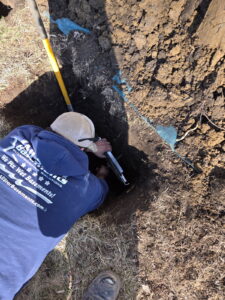
Interior Indicators: Diagonal Drywall Cracks and Sticking Doors/Windows
Inside your home, settlement presents as structural tension. Look for diagonal stress cracks starting at the upper corners of door frames and window openings. Doors that suddenly rub against their jambs, stick shut, or swing open on their own are often reacting to an uneven frame caused by a sinking foundation below.
Exterior Symptoms: Stair-Step Mortar Cracks and Chimney Separation
Step outside to inspect your home’s exterior envelope. Sinking foundations frequently cause distinct stair-step cracks in brick or concrete block masonry. You may also notice gaps opening around exterior window trim, soffits pulling away from fascia boards, or a brick chimney tilting away from the main structure.
Soil Expansion and Sinking Foundations in Olmsted County
Rochester’s geology plays a massive role in foundation performance. The region features heavy clay soils subject to extreme volume shifts driven by Upper Midwest weather patterns.
How Clay-Rich Soil and Freeze-Thaw Cycles Undermine Footers
Clay soil acts like a giant sponge. During wet spring thaws, clay absorbs water and expands, placing tremendous upward pressure on foundation walls. In deep winter, frost penetrates several feet into the earth, expanding moisture within soil pores. As temperatures fluctuate, this continuous cycle breaks down soil stability directly under load-bearing footings.
Hydrostatic Pressure vs. Soil Shrinkage During Dry Seasons
Conversely, dry summer spells cause clay soil to shrink and pull away from foundation walls, creating hollow voids beneath the concrete footer. Without uniform soil support underneath, heavy concrete walls break under their own weight and sink into these voids.
What Is Foundation Piering and How Does It Permanently Lift Your Home?
Foundation piering (or underpinning) is an engineered structural repair method that bypasses unstable topsoil and transfers your home’s load onto stable strata deep underground.
Steel Push Piers vs. Helical Piers: Which Does Your Home Need?
- Steel Push Piers: Driven deep into the earth using the structural weight of your home as resistance until they reach solid bedrock or load-bearing strata. Excellent for heavy, multi-story brick or concrete block structures.
- Helical Piers: Feature steel flight plates (screw blades) welded to the shaft. These are mechanically screwed into the earth until precise torque ratings are achieved. Ideal for lighter residential structures or structures with shallow bedrock.
The Underpinning Process: Driving Steel Rods to Load-Bearing Strata
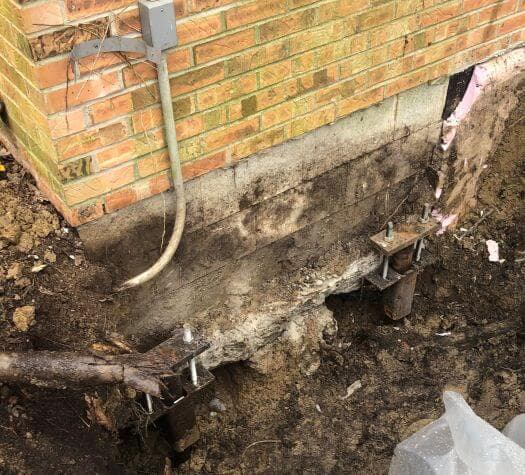
Contractors dig small, non-obtrusive excavation pits at specific locations around the perimeter footer. Heavy-duty steel foundation brackets are attached beneath the footing. Steel pier sections are then hydraulically driven through the brackets deep into stable earth far below the frost line and active soil zones.
Hydraulic Lifting: Restoring Your Home to Its Original Elevation
Once piers reach load-bearing strata, a network of synchronized hydraulic jacks is attached to the brackets. Technicians carefully lift the sunken sections back toward their original level position, closing drywall gaps and allowing sticking doors to open smoothly once again.
Foundation Piering Cost vs. The Risk of Delaying Structural Repairs
Ignoring foundation settlement never saves money. Over time, structural stress spreads to roof trusses, floor joists, and plumbing lines, leading to exponentially higher restoration costs down the road.
Average Cost Factors: Depth, Number of Piers, and Soil Conditions
Most residential piering projects require between 5 and 10 piers to stabilize a settled corner or wall section. Total costs depend on pier depth, home weight, and accessibility, but typically range from $10,000 to $25,000+ for major stabilization projects.
Why Foundation Settlement Destroys Up to 30% of Total Home Value
Unaddressed foundation failure can eliminate 15% to 30% of a home’s market value and must be disclosed to potential buyers. Installing permanent steel piers protects equity and preserves home resale marketability indefinitely.
Frequently Asked Questions (FAQ)
Q: How much does foundation piering cost per pier in Rochester, MN?
A: Steel push piers or helical piers generally cost between $1,500 and $3,000 per pier installed. The exact investment depends on the depth required to reach load-bearing strata and site accessibility.
Q: Can foundation piering be done without tearing up my basement floor?
A: Yes. The vast majority of foundation piering projects are completed entirely from the exterior by digging small access pits along the perimeter wall, preserving your interior basement finishes.
Q: Will foundation piers stop my home from sinking again in the future?
A: Yes. Steel push and helical piers anchor deep into stable bedrock or dense soil strata unaffected by surface moisture or freezing temperatures, offering a permanent structural solution backstopped by lifetime transferable warranties.
Stop Structural Settlement Before Damage Escalates
Don’t let settling soil compromise your home’s structural integrity or resale value. Call All-Star Basements today at 507-259-7776 or contact us online to schedule an on-site Structural Foundation Inspection & Engineering Evaluation in Rochester, MN.
All-Star Basements is Locally Owned and Operated and based out of Rochester, Minnesota. We cover Southern Minnesota including the Twin Cities area, Western Wisconsin and parts of Northeast Iowa. Our team is committed to solving our customers’ basement waterproofing, foundation repair, or crawl space needs and offering multiple solutions to choose from.
As a proud member of the Basement Health Association and the National Waterproof Members of America, we have the best products available to solve your leaky basement, seepage, or flooding issues. Our lineup also includes multiple crawl space solutions.
If you have foundation problems that need any kind of repair, we can help! We feature the nationally renowned Grip-Tite Foundation Systems, which has a long history over 90 years of fixing homeowners’ foundation repair issues- from walls that are buckled, tipping or cracked and bowing.
At All-Star Basements, we are committed to providing multiple solutions to choose from to help fix any basement problem you may have. We are very proud of our Better Business Bureau A+ rating and take great pride in caring for all of our customers’ needs- big or small, we do it all!